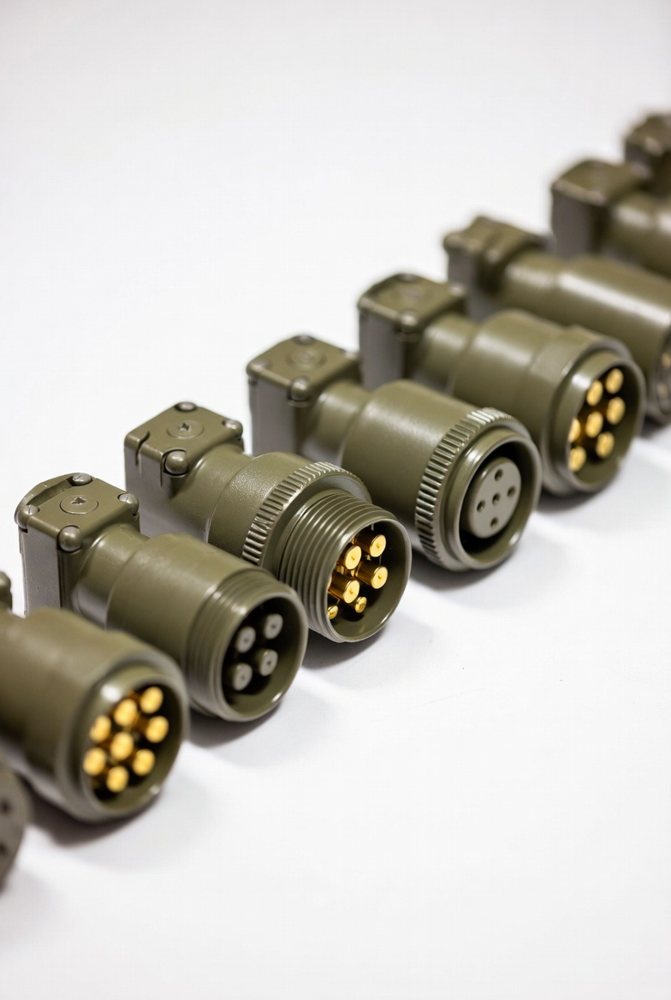
AI-generated illustration, reviewed against reference photographs. Not a photo of a real part.
Drawn to true relative scale — the variants above are directly size-comparable.
Mil Circular Connectors (D38999/MS)
Pull one contact and look down the socket bore — mil gold is a deep even brassy-yellow right down inside the barrel; commercial imitation is lemon-yellow on the outer 2 mm and grey inside.
How to spot it
Round aluminium shell with threaded or triple-start bayonet coupling and keyway splines, marked D38999/24WJ35PN, MS3106E20-17S, PT06A-, LJT or KJB. Olive-drab iridescent = cadmium; matte grey-black = electroless nickel. Shell sizes 9–25, mass 25–400 g. Found on aircraft harnesses, radar, missiles, industrial motors, marine and broadcast trucks.
Metal content
| Metal | Quantity | Notes |
|---|---|---|
| Gold | 0.20–0.50 g/lb whole; 2.5–4.0 g/lb de-pinned contacts | Glenair spec: .000050 in MIN gold, MIL-G-45204 Type II Cl I, over nickel |
| Copper | ~80 g/lb | Contact base alloy; shell is aluminium, not payable |
| Base metal | 70–85% Al 6061-T6 shell | Cd finish codes B/N/NF/J are pure liability |
At 4 Aug 2026 spot prices that works out to $40.0 per lb of contained metal — Gold 0.3 g = $39.2, Copper 80 g = $0.86. A refiner paying $35 per lb returns about 87% of that, which is normal: refining costs money and the buyer takes a margin.
Safe removal
Working temperature: Insert softening 200–230 °C
Contacts are rear-release: use the colour-coded M81969/14 insertion-extraction tool, insert from the rear, push forward, pull the wire back. Bulk method is to cut off the backshell, heat the insert to 200–230 °C to soften the fluorosilicone grommet, then press the contact block out. Do not torch, grind or burn.
Hazards
NEVER grind, burn, torch or braze cadmium-plated or AgCdO material, and don't inhale the black contact dust.
NEVER put BeCu in a grinder, a sandblaster, or a melt.
NEVER cut, drill, sand, tear or blow out suspect material with compressed air.
Before you scrap it
The common trap
Questions
How much gold is in mil circular connectors (d38999/ms)?
Gold: 0.20–0.50 g/lb whole; 2.5–4.0 g/lb de-pinned contacts. Copper: ~80 g/lb. At current spot that is about $40.0 of contained metal per pound.
How do you identify mil circular connectors (d38999/ms)?
Pull one contact and look down the socket bore — mil gold is a deep even brassy-yellow right down inside the barrel ; commercial imitation is lemon-yellow on the outer 2 mm and grey inside.
How do you remove mil circular connectors (d38999/ms) safely?
Contacts are rear-release: use the colour-coded M81969/14 insertion-extraction tool, insert from the rear, push forward, pull the wire back. Bulk method is to cut off the backshell, heat the insert to 200–230 °C to soften the fluorosilicone grommet, then press the contact block out. Do not torch, grind or burn.
Is mil circular connectors (d38999/ms) worth more working than as scrap?
Enormously more — the strongest resale case on the list. Traceable connectors carry $15–150/pc; a 100-piece clean D38999 lot clears $2,000 against ~$60 of contained gold. If the part number is legible and the insert uncracked, never scrap it.
Related in Contacts & relays
Get this offline → The full guide runs in your browser with no signal, and you can add your own photos.